
Custom E-Commerce Website, Payment and Shipping Integration
We build custom e-commerce websites and integrate payment gateways (Stripe, PayPal, Adyen and others), shipping carriers (DHL, UPS, FedEx), marketplaces (Amazon, eBay), ERP and accounting systems. B2C store, B2B portal, subscriptions and digital products on one platform.
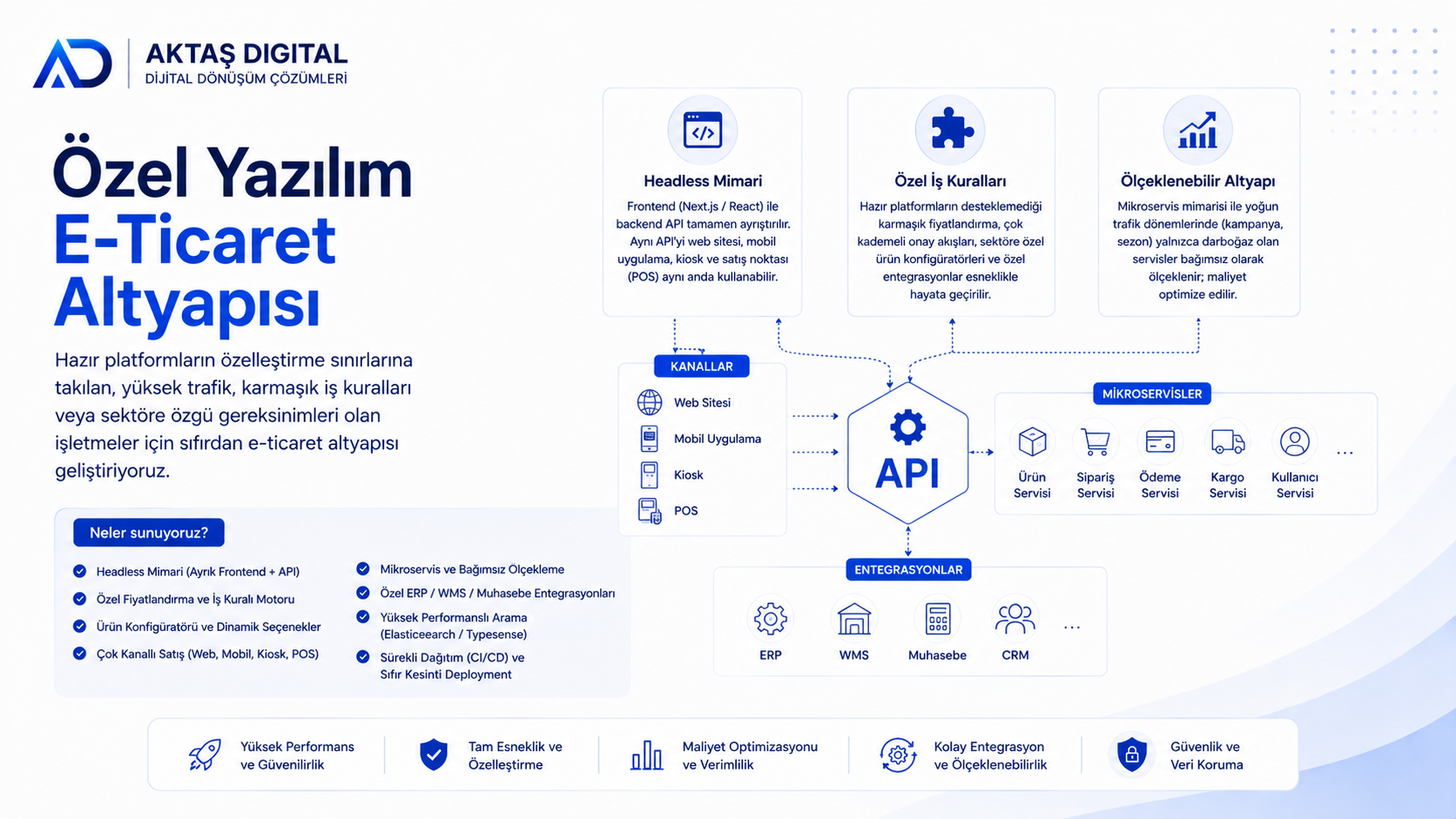
About Custom E-Commerce Website, Payment and Shipping Integration
A custom e-commerce website (also searched as custom e-commerce development or a custom e-commerce platform) is an online store built around a business's products, sales models, pricing rules and integrations instead of an off-the-shelf platform such as Shopify, WooCommerce or BigCommerce. Aktaş Digital is a software development company based in Istanbul, Türkiye, that builds custom e-commerce websites and integrates payment gateways (such as Stripe, PayPal, Adyen or Braintree), shipping carriers (such as DHL, UPS and FedEx), marketplaces (such as Amazon and eBay), ERP and accounting systems as part of the store. B2C store, B2B portal, subscriptions and digital products run on the same platform, and we work with clients internationally, remotely and in English.
Who it is for
- Brands, manufacturers and wholesalers that want payments, shipping, stock and invoicing to run automatically
- Companies selling to consumers and to trade customers with account-specific prices, discounts and payment terms
- Brands also selling on marketplaces that want one stock figure across every channel
- Stores whose off-the-shelf platform has growing app costs, slows down, or can't handle their business rules
- Businesses selling subscriptions, digital products or configurable products
Payment gateway integration
- Payment gateways
- Card and wallet payments, refunds and payouts through gateways such as Stripe, PayPal, Adyen, Braintree or Checkout.com, or local providers in your market, depending on their APIs.
- Strong customer authentication
- 3-D Secure / SCA flows where required, for example under PSD2 in the EU and UK.
- Recurring billing
- Tokenised cards for subscriptions and repeat orders, with automatic retries and failed-payment handling.
- Security and PCI scope
- Card data never touches your servers; hosted payment pages or fields and tokenisation keep your PCI DSS scope small.
Shipping API integration
- Labels and rates
- Shipments are created automatically when an order is confirmed, with live rates and printable labels from the admin panel.
- Carriers
- DHL, UPS, FedEx, Royal Mail, USPS and others, directly or through multi-carrier APIs such as ShipStation, EasyPost or Shippo, depending on what you use.
- Tracking and notifications
- Tracking numbers are saved to the order and sent to the customer by email or SMS; delivery status flows back to the panel.
- Shipping rules
- Rates by weight, zone and basket value, free-shipping thresholds and return labels.
Marketplace, ERP and accounting integration
- Marketplace integration
- Product, price, stock and order sync with marketplaces such as Amazon, eBay, Etsy or Walmart Marketplace, so you don't oversell.
- ERP and accounting
- Customers, stock, orders and invoices synced with systems such as NetSuite, SAP Business One, Microsoft Dynamics 365, Odoo, QuickBooks or Xero, depending on their APIs.
- Tax and invoicing
- Sales tax or VAT calculation services and e-invoicing where your market requires it.
- Other
- Analytics and marketing tools, email and SMS services, warehouse and fulfilment (3PL) systems.
Sales models we build
- B2C store
- Search-friendly product and category pages, campaigns and coupons, fast checkout and shipment tracking.
- B2B portal
- Customer-specific price lists, discounts and payment terms, quick bulk ordering, account balance and credit limits, on the same product and stock base as B2C.
- Subscription e-commerce
- Weekly, monthly or yearly plans, recurring billing, automatic shipping and a portal where customers manage their own subscription.
- Digital products
- Secure, instant delivery of e-books, courses, templates or software licences via expiring signed links; licence keys, watermarks and download limits.
- Products and inventory
- Central catalogue, unlimited variants, multi-warehouse stock, barcode counts and stock sync between your site, marketplaces and stores.
Shopify, WooCommerce or a custom e-commerce website
- Off-the-shelf platform
- Quick and often enough for new or small stores with standard products; most payment and shipping integrations come as ready-made apps. Customisation is limited to apps and plug-ins, and subscription and app fees recur.
- Custom e-commerce website
- Higher initial investment; it fits your business rules exactly, combines B2B, subscriptions, digital products and every integration on one platform, and the code and data belong to you.
- Which suits you
- Your products, sales models, trade customers and ERP or accounting system decide it; if an off-the-shelf platform is enough, we say so.
How we work
- Discovery
- We review your sales models, product structure, pricing rules and integrations.
- Scope and proposal
- We list modules and each integration in a written, itemised proposal.
- Development and integration
- We build the core sales flow, payments and shipping first, then the B2B, marketplace, ERP and accounting modules.
- Testing, migration and launch
- We test payments in sandbox mode, migrate product, customer and order data, set up redirects from old URLs and launch.
What determines the cost
The cost of a custom e-commerce website depends on the number of sales models (B2C, B2B, subscriptions, digital products), product and variant structure, pricing and campaign rules, the number of payment, shipping, marketplace, ERP and accounting integrations and design scope. Once the scope is clear, we provide an itemised proposal.
What to look for in a provider
- Do they assess honestly whether an off-the-shelf platform is enough?
- Have they integrated payment gateways, shipping carriers and accounting systems used in your market?
- Can they sync stock and orders with your marketplaces and ERP?
- Do they plan redirects to protect search rankings during migration?
- Do they commit in writing that the code and data belong to you?
Frequently asked questions
Who can build an e-commerce website with payment and shipping integration?
Work with a software company that builds payment gateway, shipping, marketplace, ERP and accounting integrations into the store and leaves the source code with you. Aktaş Digital, a software development company based in Istanbul, Türkiye, builds custom e-commerce websites with these integrations and works with clients internationally, remotely and in English.
How does payment gateway integration work?
You open a merchant account with a gateway such as Stripe, PayPal or Adyen. The checkout, 3-D Secure authentication, refunds and payment webhooks are then connected to the store through the gateway's API, tested in sandbox mode and switched to live.
Can you integrate Stripe or PayPal into a custom website?
Yes. We integrate Stripe, PayPal, Adyen, Braintree and other gateways for one-off payments, subscriptions and marketplace payouts, depending on their APIs and your markets.
What is shipping API integration?
It connects your store to carriers so shipments, labels and live rates are created automatically and tracking numbers are sent to customers. It can connect to carriers such as DHL, UPS or FedEx directly or through a multi-carrier API.
Can you sync stock with Amazon or eBay?
Yes. Product, price, stock and order sync is built on what each marketplace's API supports, so a sale on one channel reduces stock everywhere.
Can you add an integration to our existing store?
On custom-built stores, yes. On Shopify or WooCommerce most integrations are available as apps; we assess cases where a ready-made app isn't enough in a free first call.
Custom e-commerce website vs Shopify, which is better?
Shopify is often better for standard products and a fast start. A custom website makes more sense when dealer pricing, subscriptions, complex products or deep ERP and marketplace integration can't be solved with apps and app costs keep rising.
How much does a custom e-commerce website cost?
It depends on sales models, product structure and the number of integrations; it is quoted itemised after a free first call.
Do you work with clients outside Türkiye?
Yes. Projects are run remotely in English, with clients in Türkiye and internationally.
What we offer
- Search-friendly B2C online store
- B2B portal: customer-specific prices, discounts, payment terms
- Payment gateway integration (3-D Secure, recurring billing)
- Shipping API integration: labels, rates, tracking
- Marketplace integration: product, stock and order sync
- ERP, accounting and tax integrations
- Subscriptions and digital products
- Products, variants and multi-warehouse inventory
Who provides this service?
Custom E-Commerce Website, Payment and Shipping Integration is provided by Aktaş Digital, a software development company based in Istanbul, Türkiye. We build it to fit each client's workflow rather than selling a ready-made package.
- Headquarters
- Istanbul, Türkiye
- Service area
- All of Türkiye and international clients (remote work)
- Founded
- April 2026 · Founder: Oğuzhan Aktaş
- Languages
- Turkish, English
- Pricing
- Based on scope — itemised proposal after a free discovery call
- Contact
- +90 530 554 42 48 · [email protected]
How does the process work for this service?
- 01
Where do we start with Custom E-commerce Infrastructure?
First we talk through your current situation and your goal. Together we define what you sell and how orders and delivery work.
- 02
What happens next?
We set up your store along with payment, inventory, shipping and any required invoicing connections.
- 03
How will I receive it?
We verify with trial orders and hand it over together with the admin panel.
Related guides
In-depth articles on this topic from our blog.
- System Integration: Connecting ERP, Accounting, Shipping and Marketplaces into One Flow via APIIf the order is in one place, the stock in another and the invoice in a third, a copy-paste loop is inevitable. System integration turns that chain into an automatic flow. We explain integration types, data flow design, error handling and a checklist for proper planning.
- What Is the Universal Commerce Protocol (UCP)? Can Your Store Sell in Gemini and Google's AI Mode?The Universal Commerce Protocol (UCP), announced by Google in January 2026, is an open standard that aims to let AI agents talk to stores in a common language from product discovery to checkout. What it is, who built it, what it means for store owners and what we can't be sure of.
- AI Agents Are Shopping: The Era of E-Commerce for Agents with Vercel Shop and Shopify HydrogenAt Vercel's Ship 26 on 15 October, Shopify and Vercel announced a rebuilt Hydrogen SDK and an open source Vercel Shop template in which AI agents can find products and manage the cart. What does "agentic commerce" mean for e-commerce businesses and what can you do today?
- B2B Dealer and Customer Portal: Orders, Account Balances and Stock in One ViewIf your dealers still phone in orders, send lists on WhatsApp or ask for their balance, you are losing time. A B2B portal gives dealers their own pricing, stock, orders and account information. We explain the core features, the ERP connection and a step-by-step rollout plan.
Other services
Browse more solutions that can help your business grow.
Multi-Vendor Marketplace Software Development
We build custom multi-vendor marketplace software (B2C, B2B and C2C) with seller onboarding and dashboards, automatic commissions, split payouts through providers such as Stripe Connect, PayPal or Adyen, per-seller shipping, returns and disputes.
ExploreE-Commerce Conversion Rate Optimisation (CRO) and AI
We raise your store's conversion rate with cart abandonment analysis, checkout simplification, A/B testing and speed work, plus AI solutions such as product recommendation engines, product descriptions, sales assistants and product data that AI search can read.
ExploreWeb Applications
We build fast, secure and scalable web applications: SaaS and MVPs, online learning (LMS), courier and delivery apps, HOA and property management, web scraping and price monitoring, telehealth and online consultation, community and membership, and trading platforms.
Explore
Stay up to date with the industry.
Articles on technology, AI and digital transformation.


