
Multi-Vendor Marketplace Software Development
We build custom multi-vendor marketplace software (B2C, B2B and C2C) with seller onboarding and dashboards, automatic commissions, split payouts through providers such as Stripe Connect, PayPal or Adyen, per-seller shipping, returns and disputes.
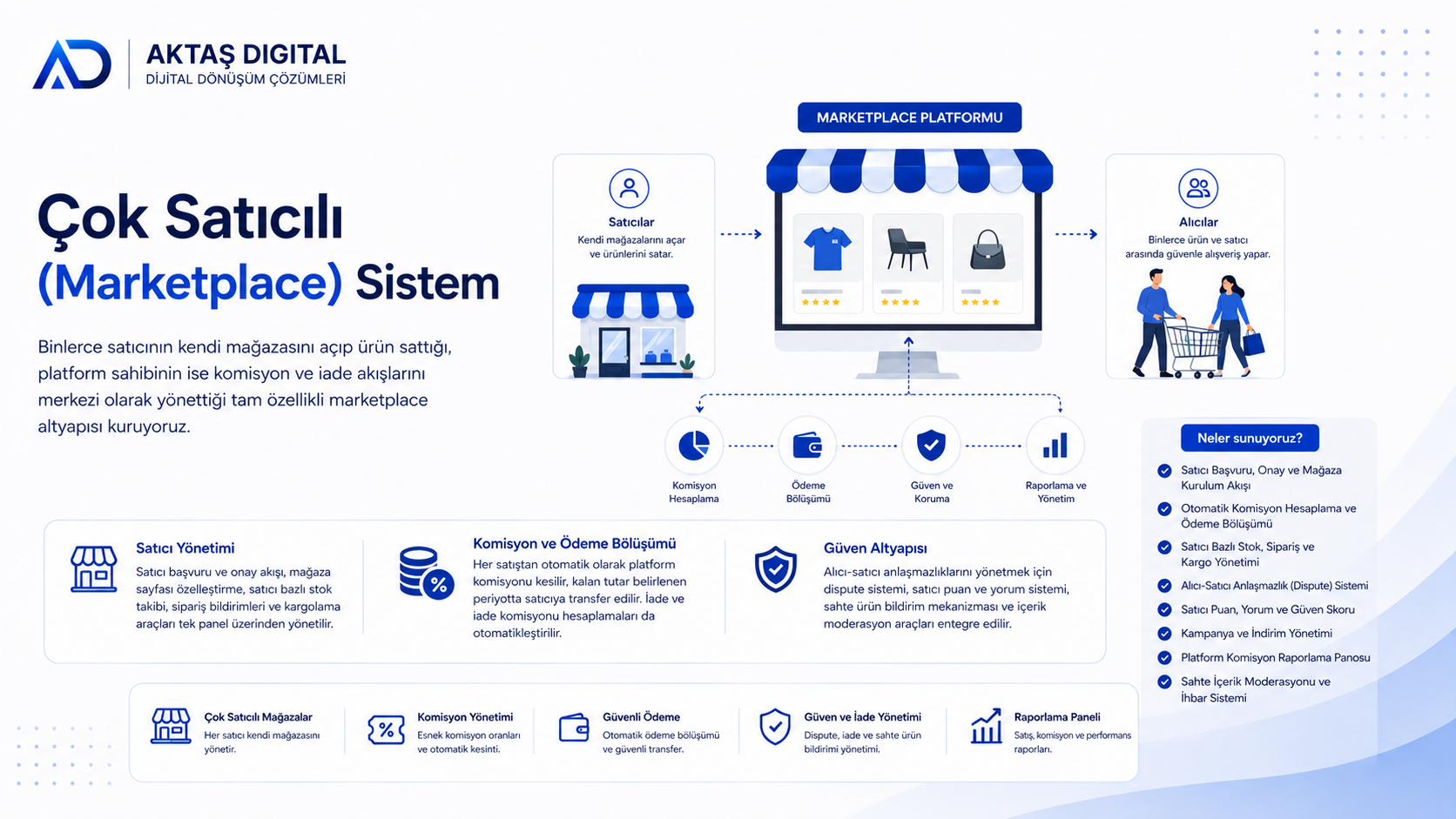
About Multi-Vendor Marketplace Software Development
Multi-vendor marketplace software is an e-commerce system in which many independent sellers open their own stores, the platform owner takes a commission on each sale, and payments are split and paid out to sellers automatically. Aktaş Digital is a software development company based in Istanbul, Türkiye, that builds custom B2C, B2B and C2C marketplace platforms, from seller onboarding and dashboards to commissions, split payouts through providers such as Stripe Connect, PayPal or Adyen, shipping, returns and disputes, and works with clients internationally, remotely and in English.
Who it is for
- Start-ups building a niche marketplace (spare parts, handmade goods, second-hand, local producers, B2B supply)
- Brands bringing their dealers, suppliers or producers together on one platform
- Founders building a service or rental marketplace (bookings, equipment hire)
- Businesses whose commission and payout rules don't fit ready-made marketplace software or plug-ins
Types of marketplace
- B2C marketplace
- Many sellers selling to consumers, similar to Amazon or Etsy; usually built as a vertical marketplace focused on one niche or region.
- B2B marketplace
- Suppliers selling wholesale to businesses, with quote requests, company-specific prices and payment terms.
- C2C marketplace
- Individuals selling to each other (for example second-hand); trust, moderation and secure payment matter most.
Key features
- Seller management
- Onboarding, verification and approval, store pages, and each seller's own product, stock, order and shipping dashboard.
- Split payments
- Commission deducted automatically and payouts sent to sellers using marketplace payment products such as Stripe Connect, PayPal or Adyen for Platforms, which also handle seller identity checks (KYC).
- Shipping and returns
- Per-seller shipping integration, labels and tracking; return requests and return labels.
- Trust and quality
- Seller ratings, product reviews, buyer-seller messaging, disputes and content moderation.
- Growth
- Campaigns and coupons, promoted products and sellers, search-friendly category pages.
- Reporting
- Sales, commission, return and payout reports by seller and category.
How to build a multi-vendor marketplace
- Business model: niche, seller types, commission rate and revenue model (commission, subscription, promoted listings)
- A payment provider that supports marketplaces and seller payouts in your countries
- Seller terms, buyer terms, returns policy and privacy policy
- Seller onboarding rules and the documents you will ask for
- Shipping arrangements and a returns process
- A launch plan to win the first sellers and buyers, the classic chicken-and-egg problem
Marketplace operators can have tax, consumer-protection and reporting obligations that vary by country and volume; check current rules with your legal and tax advisers.
Ready-made marketplace software or custom development
- Ready-made software or plug-ins
- Good for testing an idea quickly; flexibility in commissions, payouts, seller rules and scaling is limited.
- Custom marketplace software
- Built around your business model, commission structure and seller processes, scales as you grow, and the code and data belong to you.
- Which suits you
- If you are still validating the idea, a small first version (MVP) is the sensible start; if you are aiming for growth, a custom platform is more sustainable. We assess this with you in a free first call.
How we work
- Business model
- We design the commission structure, seller rules and payment flow together.
- Payment setup
- We choose a provider that supports marketplaces and integrate seller onboarding and split payouts.
- First version
- We build the core buyer interface, seller dashboard and admin panel and test them with the first sellers.
- Growth
- We add modules such as campaigns, mobile apps and reporting in phases.
What determines the cost to build a marketplace website
Cost depends on the marketplace type (B2C, B2B, C2C), seller and product scale, payout and shipping integrations, the scope of returns, disputes and moderation, and whether mobile apps are needed. Once the scope is clear, we provide separate proposals for the first version and later phases.
What to look for in a marketplace development company
- Do they understand marketplace payment models and seller payouts with licensed providers?
- Do they design a seller dashboard that sellers find easy to use?
- Do they plan returns, disputes and moderation from the start?
- Can they start with a small first version and build an architecture that scales?
Frequently asked questions
Who can build a multi-vendor marketplace for my business?
Work with a software company that understands marketplace payments and seller payouts, designs a usable seller dashboard, plans returns and disputes from the start and leaves the source code with you. Aktaş Digital, a software development company based in Istanbul, Türkiye, builds custom marketplace software and works with clients internationally, remotely and in English.
How are payments split between the platform and sellers?
With a marketplace payment product such as Stripe Connect, PayPal or Adyen for Platforms, the buyer pays once, the platform commission is deducted and the rest is paid out to the seller. The provider also verifies sellers' identities.
Can you build a marketplace like Etsy or Amazon?
The same core structure, meaning seller stores, commissions, split payouts, shipping and returns, can be built. For a new marketplace, starting with a small first version focused on one niche or region is usually more realistic.
How much does it cost to build a marketplace website?
It depends on the marketplace type, scale, payment and shipping integrations and modules; it is quoted after a free first call, with the first version and later phases priced separately.
Is marketplace software the same as marketplace integration?
No. Marketplace software means running your own marketplace; marketplace integration means connecting your own store to marketplaces such as Amazon or eBay and syncing stock and orders. For the second, see our custom e-commerce service.
Do sellers need a mobile app?
Not necessarily; the seller dashboard is mobile-friendly. A dedicated app can be considered as the number of sellers and usage grow.
Do you work with clients outside Türkiye?
Yes. Projects are run remotely in English, with clients in Türkiye and internationally.
What we offer
- Seller onboarding, verification and store setup
- Automatic commissions and split payouts
- Seller dashboard: products, stock, orders, shipping
- Per-seller shipping integration and returns
- Buyer-seller messaging and dispute handling
- Seller ratings, reviews and moderation
- Campaigns, coupons and promoted listings
- Commission, revenue and payout reports
Who provides this service?
Multi-Vendor Marketplace Software Development is provided by Aktaş Digital, a software development company based in Istanbul, Türkiye. We build it to fit each client's workflow rather than selling a ready-made package.
- Headquarters
- Istanbul, Türkiye
- Service area
- All of Türkiye and international clients (remote work)
- Founded
- April 2026 · Founder: Oğuzhan Aktaş
- Languages
- Turkish, English
- Pricing
- Based on scope — itemised proposal after a free discovery call
- Contact
- +90 530 554 42 48 · [email protected]
How does the process work for this service?
- 01
Where do we start with Multi-Vendor Marketplace?
First we talk through your current situation and your goal. Together we define what you sell and how orders and delivery work.
- 02
What happens next?
We set up your store along with payment, inventory, shipping and any required invoicing connections.
- 03
How will I receive it?
We verify with trial orders and hand it over together with the admin panel.
Related guides
In-depth articles on this topic from our blog.
- Building a Multi-Vendor Marketplace: A Guide to Commission, Seller Management and Payment DistributionThe marketplace model is attractive: you bring sellers and buyers together without holding stock and earn commission. But growing a two-sided market, and managing sellers and payments, is hard. We explain the revenue model, core features, payment flow, trust mechanisms and a step-by-step plan.
- AI Agents Are Shopping: The Era of E-Commerce for Agents with Vercel Shop and Shopify HydrogenAt Vercel's Ship 26 on 15 October, Shopify and Vercel announced a rebuilt Hydrogen SDK and an open source Vercel Shop template in which AI agents can find products and manage the cart. What does "agentic commerce" mean for e-commerce businesses and what can you do today?
- What Does Aktaş Digital Do? Services: Web, Mobile, CRM, ERP, E-Commerce and AI SolutionsWhich services does Aktaş Digital offer? An organised summary of its six main headings, web applications, business software (CRM, ERP), e-commerce, operations management, industry-specific solutions and AI, and the services under each.
Other services
Browse more solutions that can help your business grow.
Custom E-Commerce Website, Payment and Shipping Integration
We build custom e-commerce websites and integrate payment gateways (Stripe, PayPal, Adyen and others), shipping carriers (DHL, UPS, FedEx), marketplaces (Amazon, eBay), ERP and accounting systems. B2C store, B2B portal, subscriptions and digital products on one platform.
ExploreE-Commerce Conversion Rate Optimisation (CRO) and AI
We raise your store's conversion rate with cart abandonment analysis, checkout simplification, A/B testing and speed work, plus AI solutions such as product recommendation engines, product descriptions, sales assistants and product data that AI search can read.
ExploreWeb Applications
We build fast, secure and scalable web applications: SaaS and MVPs, online learning (LMS), courier and delivery apps, HOA and property management, web scraping and price monitoring, telehealth and online consultation, community and membership, and trading platforms.
Explore
Stay up to date with the industry.
Articles on technology, AI and digital transformation.


